ModelForm — Layout
examples/16_form_layout.py · run it with uv run python examples/16_form_layout.py
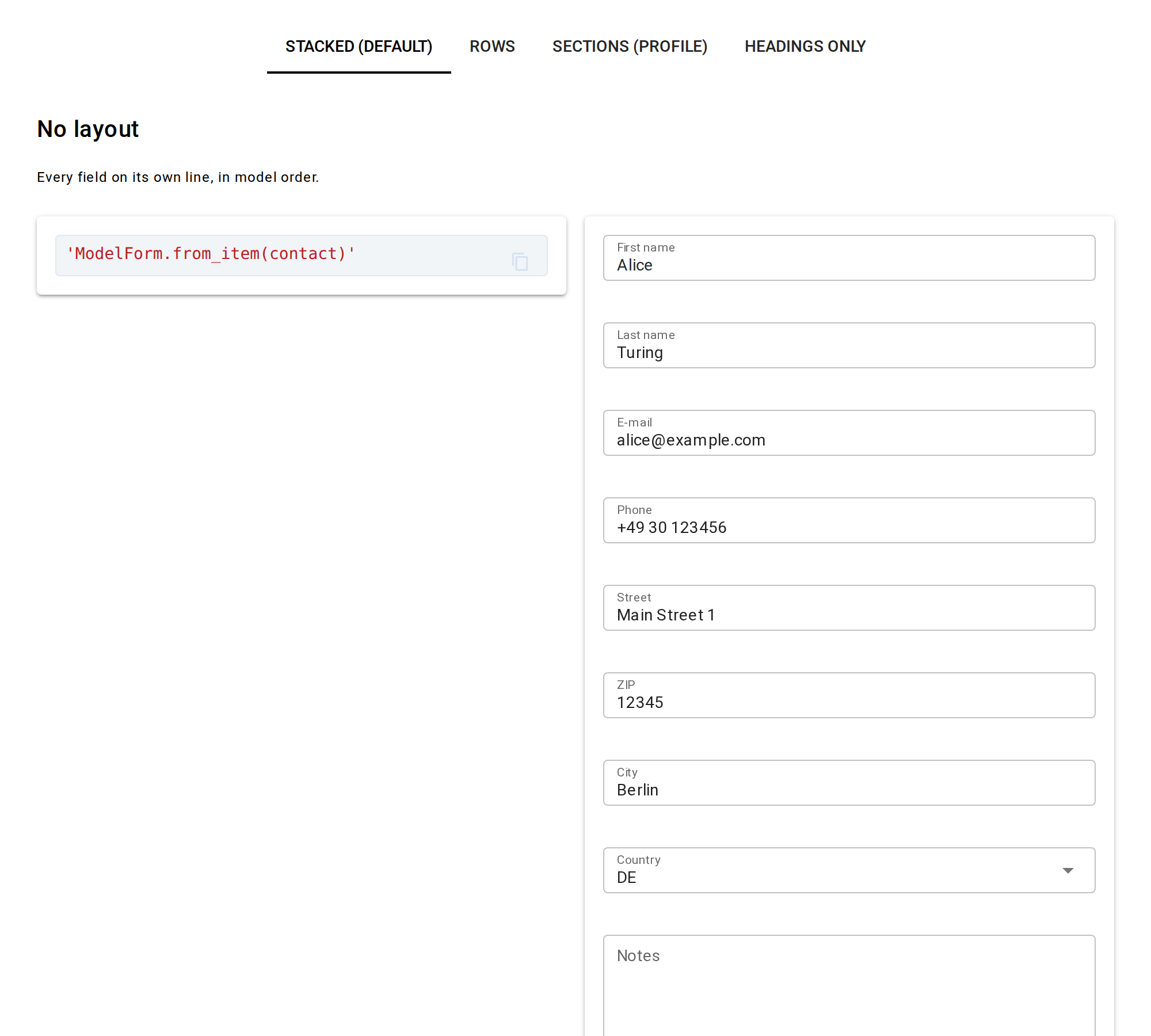
By default a form stacks its fields. A layout arranges them, written as a nested list of
field names — in Meta.profiles when it belongs to the model, or as layout= for one form.
| Notation | Meaning |
|---|---|
'city' |
the field |
'zip_code:sm:w-1/3' |
the field, with CSS classes — only the first colon separates, so Tailwind prefixes (sm:, hover:) stay intact |
['zip_code', 'city'] |
a nested list opens a container: rows and columns alternate with each level |
'# Address' |
as the first element: the group becomes a card with that title |
'## Address' |
the same heading without the card — the group stays a plain column |
':gap-8 items-end' |
as the first element: replaces the container's default classes |
Two rules worth knowing, both about not fighting Tailwind:
- Fields in a row share the width evenly (
flex-1). A field that brings its own classes gets those instead —flex-1setsflex-basis: 0and would silently win over any width. - Container classes replace the defaults instead of adding to them:
gap-4 gap-8is decided by stylesheet order, not by the order in the class list.
The layout also defines which fields are rendered, exactly like a profile — see the third tab,
where notes is missing on purpose. What the notation cannot express, form.render_field()
still can: it places one field wherever you call it.
Uniform styling is a separate knob: base_props and default_classes apply to every widget
of the form, whatever its type — ui.select and ui.input_chips included, which
ui.input.default_props() would miss. The two behave differently on purpose:
base_propsis a base: the field's own props are merged on top, per key, so a field can add or change one prop without repeating the rest.default_classesis a fallback: classes cannot be merged meaningfully ('w-full w-1/2'is decided by stylesheet order), so any classes on the field or in the layout replace it.
Source
"""
# ModelForm — Layout

By default a form stacks its fields. A **layout** arranges them, written as a nested list of
field names — in `Meta.profiles` when it belongs to the model, or as `layout=` for one form.

| Notation | Meaning |
|---|---|
| `'city'` | the field |
| `'zip_code:sm:w-1/3'` | the field, with CSS classes — only the **first** colon separates, so Tailwind prefixes (`sm:`, `hover:`) stay intact |
| `['zip_code', 'city']` | a nested list opens a container: rows and columns alternate with each level |
| `'# Address'` | as the **first** element: the group becomes a card with that title |
| `'## Address'` | the same heading without the card — the group stays a plain column |
| `':gap-8 items-end'` | as the **first** element: replaces the container's default classes |

Two rules worth knowing, both about not fighting Tailwind:

- Fields in a row share the width evenly (`flex-1`). A field that brings its own classes gets
  those *instead* — `flex-1` sets `flex-basis: 0` and would silently win over any width.
- Container classes **replace** the defaults instead of adding to them: `gap-4 gap-8` is decided
  by stylesheet order, not by the order in the class list.

The layout also defines *which* fields are rendered, exactly like a profile — see the third tab,
where `notes` is missing on purpose. What the notation cannot express, `form.render_field()`
still can: it places one field wherever you call it.

Uniform styling is a separate knob: `base_props` and `default_classes` apply to **every** widget
of the form, whatever its type — `ui.select` and `ui.input_chips` included, which
`ui.input.default_props()` would miss. The two behave differently on purpose:

- `base_props` is a **base**: the field's own props are merged on top, per key, so a field can
  add or change one prop without repeating the rest.
- `default_classes` is a **fallback**: classes cannot be merged meaningfully (`'w-full w-1/2'`
  is decided by stylesheet order), so any classes on the field or in the layout replace it.
"""

import pprint
from typing import Annotated, Literal

import pydantic
from nicegui import ui

import niceview
from niceview import ModelForm


class Contact(pydantic.BaseModel):
    first_name: str = pydantic.Field(default='Alice', title='First name')
    last_name: str = pydantic.Field(default='Turing', title='Last name')
    email: str = pydantic.Field(default='alice@example.com', title='E-mail',
                                description='We only use it for the order confirmation')
    phone: str = pydantic.Field(default='+49 30 123456', title='Phone')
    street: str = pydantic.Field(default='Main Street 1', title='Street')
    zip_code: str = pydantic.Field(default='12345', title='ZIP')
    city: str = pydantic.Field(default='Berlin', title='City')
    country: Literal['DE', 'AT', 'CH'] = pydantic.Field(default='DE', title='Country')
    notes: Annotated[str, niceview.Field(widget_type='ui.textarea')] = pydantic.Field(
        default='', title='Notes')

    class Meta:
        # A profile may be nested: it is a field selection *and* an arrangement. Grids and
        # lists read the same entry and simply ignore the nesting.
        profiles = {
            'card': [
                ['# Name', ['first_name', 'last_name']],
                ['# Address', 'street', ['zip_code:sm:w-1/3', 'city'], 'country:sm:w-1/2'],
            ],
            # Same sections, one '#' less: the headings stay, the frames go.
            'headings': [
                ['## Name', ['first_name', 'last_name']],
                ['## Address', 'street', ['zip_code:sm:w-1/3', 'city'], 'country:sm:w-1/2'],
            ],
        }


ROWS = [
    ['first_name', 'last_name'],
    ['email', 'phone'],
    'street',
    [':gap-8', 'zip_code:sm:w-1/3', 'city'],
    'country:sm:w-1/2',
    'notes',
]


# Applied to every widget of the form, whatever its type. 'w-full' makes a field fill its
# container; inside a row 'flex-1' is added on top, and a layout hint like 'sm:w-1/3' replaces
# 'w-full' entirely — which is exactly what a per-field width should do.
FORM_STYLE = {'base_props': 'outlined dense', 'default_classes': 'w-full'}


def show(title: str, description: str, source: object, render) -> None:
    """One tab: the layout literal on the left, the form it produces on the right."""
    ui.label(title).classes('text-h6')
    ui.label(description).classes('text-caption')
    with ui.row().classes('w-full items-start gap-4 mt-2'):
        with ui.card().classes('flex-1'):
            ui.code(pprint.pformat(source, width=64, sort_dicts=False), language='python').classes('w-full')
        with ui.card().classes('flex-1'):
            render()


@ui.page('/')
def page():
    ui.markdown(__doc__ or '')
    ui.separator()

    with ui.tabs().classes('w-full') as tabs:
        tab_stacked = ui.tab('Stacked (default)')
        tab_rows = ui.tab('Rows')
        tab_sections = ui.tab('Sections (profile)')
        tab_headings = ui.tab('Headings only')

    with ui.tab_panels(tabs, value=tab_stacked).classes('w-full'):
        with ui.tab_panel(tab_stacked):
            show('No layout', 'Every field on its own line, in model order.',
                 'ModelForm.from_item(contact)',
                 lambda: ModelForm.from_item(Contact(), **FORM_STYLE).render())

        with ui.tab_panel(tab_rows):
            show('layout=[...]', 'Nested lists open rows; the ZIP keeps a third of the line.',
                 ROWS,
                 lambda: ModelForm.from_item(Contact(), layout=ROWS, **FORM_STYLE).render())

        with ui.tab_panel(tab_sections):
            show("profile='card'", 'Titled groups render as flat bordered cards. Note that `notes` is not part of this profile.',
                 Contact.Meta.profiles['card'],
                 lambda: ModelForm.from_item(Contact(), profile='card', **FORM_STYLE).render())

        with ui.tab_panel(tab_headings):
            show("profile='headings'", "'##' keeps the section title and drops the card around it.",
                 Contact.Meta.profiles['headings'],
                 lambda: ModelForm.from_item(Contact(), profile='headings', **FORM_STYLE).render())


ui.run(title='16 — Form Layout')